Read the Situation
The question is immediate and practical: what is happening here? A read of the market, the context, and the problem as it actually presents.
Growth slows. Leads become inconsistent. The website no longer feels right. Teams begin questioning the messaging, the campaign, the brand, or the sales process. These are often treated as marketing problems because marketing is where they become visible.
But the source may lie elsewhere. A company can outgrow the story it has been telling about itself. Markets shift while old assumptions remain in place. Different parts of an organization begin describing the same thing in different ways. Over time, those conditions surface in communication.
Visible problems matter. They are just not always where the story begins.
Marketing can clarify a direction. It cannot create one. When the underlying questions remain unresolved, communication often ends up carrying more weight than it should. The work begins by looking beyond the symptom, not to avoid it, but to understand what produced it.

The symptom appears where it can be seen
The cause often does not
A company revises its website three times in two years and still struggles to explain what it does. A sales team asks for better marketing while prospects continue asking the same questions. A business invests more effort into communication but finds itself having the same conversations six months later.
The work changes. The questions remain.
This does not mean the website was unimportant. Or that marketing does not matter. It means that communication often reveals conditions that already exist. Sometimes the words are unclear. Sometimes the offer has drifted, or the market has changed, or different parts of the organization are working from different assumptions. Until those conditions are understood, it becomes difficult to know what should actually be fixed.
The visible problem is real. Growth slows. Leads become inconsistent. The message feels unclear, customers hesitate, and teams feel pressure to act. These are the moments that attract attention. They are tangible, measurable, and difficult to ignore.

What is less visible are the questions that have not yet been answered, the assumptions that no longer hold, and the decisions whose consequences only become apparent later. A company may have outgrown its original story. A market may have shifted while internal thinking remained the same. Different parts of an organisation may be moving toward different interpretations of the future.
The visible problem is rarely imagined. It is simply not always alone.
Most problems arrive with an obvious explanation. Growth slows, so marketing becomes the concern. The website feels dated, so it is redesigned. The message feels unclear, so it is rewritten.
Sometimes those actions help. Sometimes they do not. Not because the response was wrong, but because it addressed where the condition appeared rather than what may have produced it.
A company can spend months refining its message and still struggle to explain why customers choose it. Another can redesign its website and find itself having the same conversations six months later. A leadership team can agree on goals while holding very different ideas about what the organisation actually is.
What begins as a question about communication often becomes a conversation about something else. The work moves gradually from what is visible toward what is influencing it. Not in search of hidden complexity.
In search of enough clarity to know what deserves attention and what does not.
Some situations arrive with urgency. A launch is approaching, growth has stalled, a decision needs to be made.
The question is immediate and practical: what is happening here? A read of the market, the context, and the problem as it actually presents.
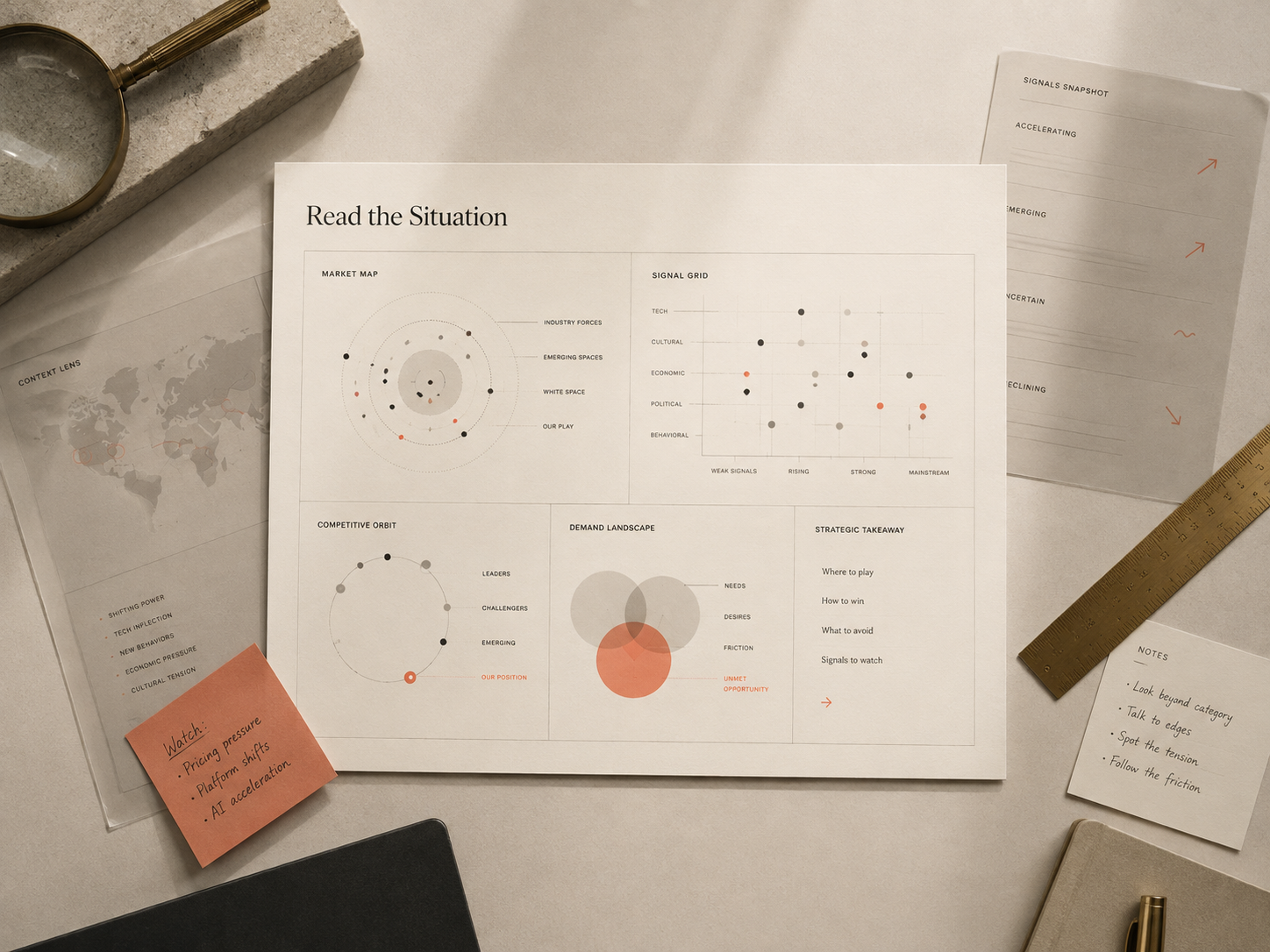
Other situations arrive differently. Less as a problem to solve and more as a pattern that keeps returning. The same questions. The same tensions. The same uncertainty showing up in different forms. The question becomes: what are we missing?
Sibling chapters: El Retrato · El Revelado · El Encuadre

One read focuses on the situation. The other focuses on the practice behind it. Both begin from the same place: paying attention to what is present before deciding what it means.
Once the read makes what matters visible, the work continues: deciding what should lead, aligning the path, and building what lasts.
Make visible what matters.
Before deciding what to do, we observe what is already present. Patterns, tensions, contradictions, and signals that usually stay hidden behind the visible problems.
Decide with clarity. Align the path.
Once what matters becomes visible, the task is to decide what deserves attention, what should lead, and how to align the organisation around a shared direction.
Create what lasts. Make it real.
Decisions only gain value when they take shape. Building turns clarity and direction into something tangible, consistent, and able to hold over time.
Some ideas require more space. Not because they are complicated, but because they take time to unfold.
The Pattern I Couldn’t Ignore
Founding / origin essay · why the pattern kept appearing.
The Translation Problem
Editorial lens · what gets lost between intention and expression.
El Retrato
Entry to Read the Practice · then El Revelado and El Encuadre.
StrategyIQ
Read the Situation · diagnostic instrument for clarity and decision.
The essays are a place for observations gathered over years of work, conversations, and practice. They are not instructions. They are attempts to understand. Some begin with communication. Others begin somewhere else entirely. Most end up circling the same question.
What becomes possible once we start paying attention to what is actually there?